Understanding the Foundation of Modern Cybersecurity
When exploring what are zero trust security models, it helps to understand that this is a comprehensive cybersecurity strategy and framework built on the foundational rule: "never trust, always verify." For anyone looking to understand A Comprehensive Review of Cyber Security: Key Points and Takeaways, this concept represents a major shift in how modern organizations protect sensitive information. The concept of Zero Trust was first coined in 2010 by John Kindervag, who was then an analyst at Forrester Research. Since its inception, it has revolutionized how digital defenders think about network safety, moving away from complacency and demanding continuous proof of safety across all enterprise environments.
 TechMediaArch.com TechMediaArch.com |
| Digital network with verification nodes representing zero trust security |
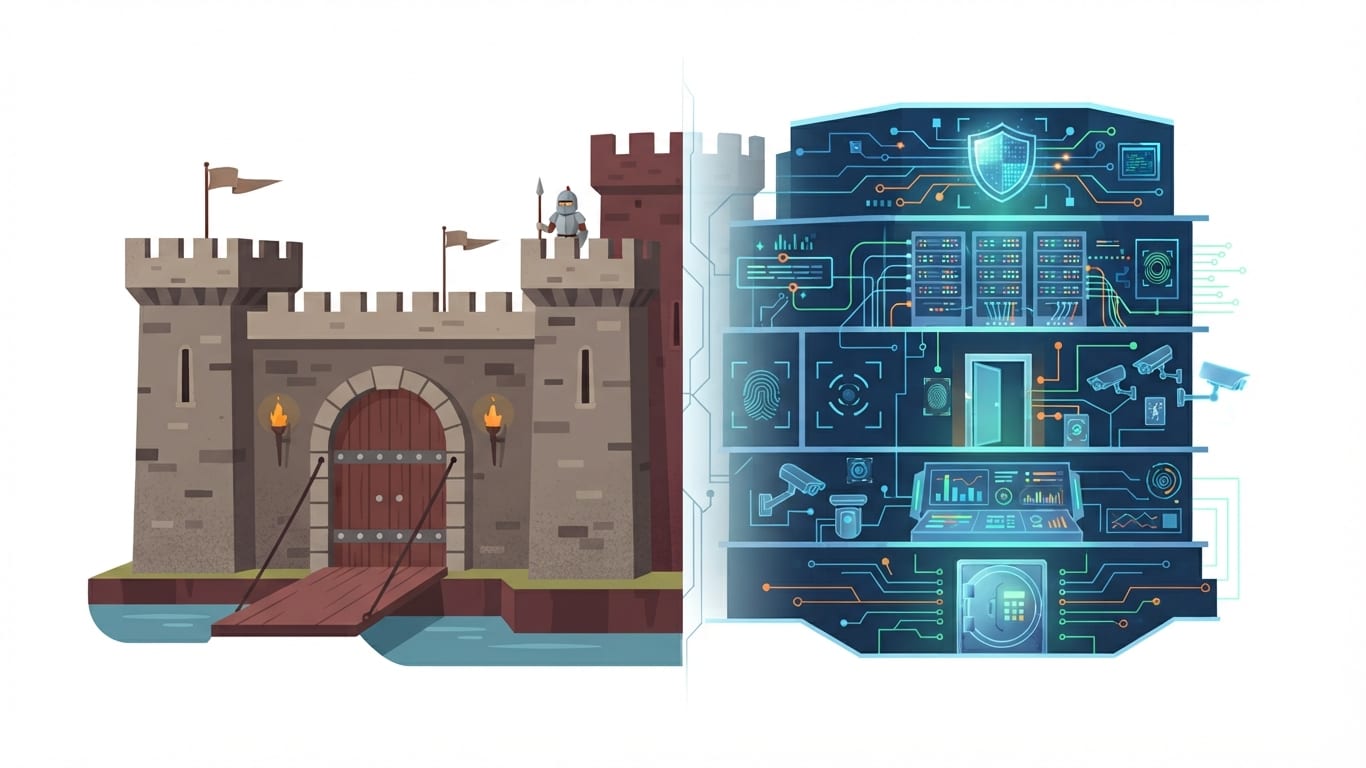
Traditional security models relied heavily on a "castle-and-moat" approach. This older method trusted everything inside the network perimeter implicitly, operating under the dangerous assumption that anyone who managed to get past the outer wall was safe and authorized. Unfortunately, this leaves systems deeply vulnerable once a perimeter is breached, as internal actors or compromised credentials have free rein over critical assets. To counter modern threats like those outlined in guides on What is Ransomware in Cyber Security: A Complete Guide, contemporary digital defenses must evolve past traditional boundaries. Understanding this shift is the first step toward building a resilient security posture capable of withstanding sophisticated lateral movement, insider threats, and highly coordinated external cyber attacks.
Organizations today operate in deeply interconnected digital landscapes where cloud services, remote workforces, and mobile devices have effectively dissolved the physical boundaries of the corporate office. Because the traditional perimeter no longer exists in a tangible sense, security strategies must adapt to secure assets wherever they reside. Adopting a framework rooted in continuous verification ensures that even as network boundaries shift, the fundamental rules governing access remain robust, immutable, and strictly enforced.
The Shift Away From Traditional Perimeters
The core philosophy behind a zero trust security model is the complete rejection of implicit trust. Traditional network architecture assumed that once a user or device proved their identity at the outer boundary of the network, they were safe to roam freely inside. This strategy proved dangerous because modern cyberattacks frequently bypass outer defenses through compromised credentials or phishing attacks, similar to the tactics discussed in resources covering What Are Phishing Emails and How Do Cyberattacks Work?. Once an attacker slips through the front door using stolen credentials, legacy networks give them unfettered access to sensitive databases, intellectual property, and administrative controls.
Zero Trust eliminates implicit trust entirely by treating all users, devices, applications, and network traffic as untrusted by default. This holds true regardless of whether they originate inside or outside the corporate network. By abandoning the idea that an internal network is inherently safe, organizations can better protect themselves against sophisticated intruders who manage to slip past the initial gateway. Under this modern mindset, an employee sitting at a desk inside corporate headquarters is treated with the exact same level of scrutiny and skepticism as an unknown visitor logging in from a public Wi-Fi network halfway across the world.
This radical departure from legacy thinking requires security teams to redesign their infrastructure entirely. Instead of focusing money and effort on hardening perimeter firewalls, budget is redirected toward internal visibility, strict access controls, and deep behavioral analytics. By ensuring that every single transaction is scrutinized independently of network origin, enterprises create an environment where a single compromised credential does not spell total disaster for the entire corporate network.
Core Principles: Verify Explicitly and Least Privilege
To operationalize this security philosophy, organizations rely on specific foundational guidelines. When examining what are zero trust security principles, the first major pillar is verifying explicitly. This means requiring the authentication and authorization of every single access request based on all available data points—such as user identity, location, and device health—in real time, rather than just checking credentials once at the entry point. Every transaction must be evaluated on its own merits, taking into account contextual factors like whether the device is company-owned, whether the operating system is fully patched, and whether the access attempt aligns with normal working hours.
The second core principle involves using least privilege access. Under this rule, users, devices, and applications are granted only the minimum level of access and permissions necessary to perform their specific tasks. For example, a data analyst does not need administrative privileges over the human resources database, and a marketing application does not need write access to financial ledgers. By restricting access to only what is strictly required for daily operations, organizations minimize potential damage if a user account or device becomes compromised by malicious actors. Even if an adversary manages to hijack a user's credentials, the blast radius is artificially contained because those credentials lack broad, sweeping permissions.
Implementing these two principles requires continuous evaluation rather than static rules. Security policies must dynamically adjust based on changing conditions. If a user's device suddenly exhibits signs of malware infection or attempts to access unusual repositories, the system can instantly revoke permissions or step up authentication requirements, ensuring that security adapts to reality in real time.
Assuming Breach and Containing Threats
Another vital aspect of this methodology is the proactive mindset of assuming breach. Zero Trust operates under the constant assumption that network breaches are inevitable. Instead of focusing entirely on keeping intruders out—which is an impossible guarantee in today's threat landscape—security teams build controls focused on containing threats and mitigating lateral movement within the network. This approach acknowledges that sophisticated attackers will eventually find a way in, whether through a zero-day vulnerability, an advanced phishing campaign, or a careless third-party vendor.
This proactive mindset changes how security architects design networks. Because they assume an attacker is already inside, systems are built with internal walls, constant verification checkpoints, and rigid segmentation. If a malicious entity compromises one workstation, they find themselves blocked from moving freely to other parts of the organization. They cannot easily pivot to domain controllers or critical data repositories because every internal step requires separate, explicit authorization. This drastically reduces the potential impact of a security incident and buys valuable time for security operations centers to detect, isolate, and neutralize the threat.
Assuming breach also transforms incident response strategies. Security teams shift from chasing a mythical 100% prevention rate to focusing on detection speed and blast radius minimization. By designing architectures that expect failure at the perimeter, organizations ensure that a localized compromise never escalates into a catastrophic enterprise-wide outage or data leak.
 TechMediaArch.com TechMediaArch.com |
| Comparison illustration of traditional castle moat security versus modern architecture |
Identity and Access Management as a Cornerstone
Identity and Access Management (IAM) serves as a cornerstone pillar of Zero Trust. In a world where perimeter walls no longer guarantee safety, verifying who is knocking on the digital door becomes paramount. IAM moves far beyond simple passwords, which are easily guessed, stolen, or phished in modern cyber campaigns.
Instead, modern architectures incorporate multi-factor authentication (MFA), biometrics, and physical security keys. By requiring multiple layers of verification for every login attempt, organizations ensure that even if an attacker steals a password through social engineering, they still cannot access sensitive systems without the secondary verification factor, such as a biometric scan or a time-based one-time passcode generated by a trusted hardware token.
Furthermore, modern IAM systems integrate deeply with contextual risk engines. When a user requests access, the IAM solution evaluates not just the password and MFA token, but also behavioral baselines. It analyzes whether the typing cadence matches the user, whether the login location makes physical sense, and whether the device attempting the connection has been registered and verified by IT. This comprehensive approach ensures that identity verification is rigorous, continuous, and practically impossible for unauthorized actors to spoof.
Microsegmentation and Zero Trust Network Access
Securing the interior of a network requires advanced architectural tools. Zero Trust uses granular network microsegmentation from the inside to isolate resources and restrict traffic between machines or application workloads. Instead of a flat network where everything talks to everything else, microsegmentation creates isolated pockets of security around specific applications or data sets. This practice drastically shrinks the "blast radius" of any potential breach, ensuring that an intrusion in one small segment cannot easily spread to adjacent systems.
Additionally, Zero Trust Network Access (ZTNA) delivers secure remote access from the outside. Instead of extending the broader corporate network to remote workers via traditional virtual private networks—which historically gave users full network access once connected—ZTNA connects users directly to specific individual applications. This modern approach eliminates the exposure of public IP addresses, keeps unauthorized applications hidden from potential network scanners, and ensures that even remote employees only interact with the exact tools they need to do their jobs.
By combining microsegmentation for internal workloads and ZTNA for external connections, organizations effectively dismantle the flat network architectures of the past. Every communication path becomes intentional, authenticated, and explicitly authorized, leaving no room for attackers to wander unseen through internal infrastructure.
Continuous Monitoring and Risk Scoring
Security is not a one-time setup; it is an ongoing process. Modern Zero Trust architectures use continuous monitoring and artificial intelligence or machine learning-driven contextual risk scoring. These systems dynamically evaluate user sessions and adapt policies in real time, recognizing that a session that starts out safe can become suspicious over time.
If a user's behavior changes mid-session—such as downloading an unusual volume of files, exhibiting erratic navigation patterns, or logging in from an anomalous geographic location—the system can automatically adjust privileges. Depending on the evaluated risk level, the architecture can allow, block, or completely isolate the session to protect organizational assets without requiring immediate human intervention from overburdened security analysts.
Continuous monitoring also ensures compliance and visibility. Security teams gain deep telemetry into every interaction happening across the enterprise, allowing them to audit access logs, identify emerging vulnerabilities, and refine security policies based on empirical behavioral data rather than guesswork.
Steps on How to Implement Zero Trust Security
Organizations often wonder how to implement zero trust security given its comprehensive and intimidating nature. Data shows that while roughly 90% of cybersecurity professionals view Zero Trust as vital to enhancing their security posture, about 90% of organizations still struggle to fully operationalize or achieve advanced maturity in it. A structured, phased approach helps bridge this gap, ensuring that security teams do not become overwhelmed by the scope of the transformation.
Implementing Zero Trust typically begins by identifying an organization's critical "protected surface," which includes essential data, applications, assets, and services (DAAS). Unlike the entire network perimeter, the protected surface is small, highly specific, and contains the organization's most valuable crown jewels. Once this surface is defined, organizations map out the data flows, transaction paths, and dependencies associated with those critical assets to understand how traffic interacts with them.
Next, organizations map out their existing security stack—such as identity providers, gateways, and monitoring tools—to identify coverage gaps and repurpose tools to fit Zero Trust policies. Rather than ripping out existing technology investments, security leaders audit what they already own and configure those tools to support explicit verification, least privilege access, and continuous monitoring.
Deploying Enforcements and Frameworks
To complete the journey, organizations must look closely at what is zero trust security architecture and what are zero trust security frameworks. Deploying a comprehensive framework incorporates new layers like single sign-on (SSO), microsegmentation controls, device health checkers, and automated policy enforcers. These components work in unison to enforce the "never trust, always verify" mandate across every layer of the digital ecosystem.
Because there is no single product that instantly grants Zero Trust status, organizations must weave these diverse tools together into a cohesive ecosystem. Identity providers enforce explicit verification, ZTNA and microsegmentation isolate traffic, and continuous monitoring engines dynamically score risk. By following structured deployment steps and continuously refining policies, security teams can successfully transition from legacy perimeter defenses to a resilient, verification-driven model that stands strong against modern cyber threats.
FAQ
What is a zero trust security model?
It is a cybersecurity strategy and framework built on the foundational rule of "never trust, always verify," eliminating implicit trust for all users and devices.
What are zero trust security principles?
The core principles include verifying explicitly using real-time data points, granting least privilege access, and assuming that a network breach is inevitable.
How to implement zero trust security?
Implementation involves mapping the protected surface of essential data and assets, auditing existing security controls, and deploying tools like single sign-on and microsegmentation.
What is zero trust security architecture?
It is an infrastructure design that uses continuous monitoring, microsegmentation, and dynamic risk scoring to secure networks from the inside out.
What are zero trust security frameworks?
They are structured guidelines and toolsets—incorporating IAM, ZTNA, and device health checkers—that organizations use to operationalize continuous verification and threat containment.