Understanding the Core Difference Between Large Language Models and Generative AI
When exploring modern technology, many people wonder about the exact difference between large language models and generative ai. At its core, the relationship is hierarchical rather than an either-or choice. Generative AI serves as a broad category of artificial intelligence that encompasses all creative AI tools designed to produce original content across various mediums, including images, music, video, and text. On the other hand, large language models are a specific type of generative model engineered specifically to process, understand, and generate human-like text and language-based tasks. Understanding this distinction helps clarify how different software applications operate in the modern landscape, especially as global technology shifts and new platforms emerge, much like how China's DeepSeek AI Models Send Shockwaves Through Tech Community across the industry.
 TechMediaArch.com TechMediaArch.com |
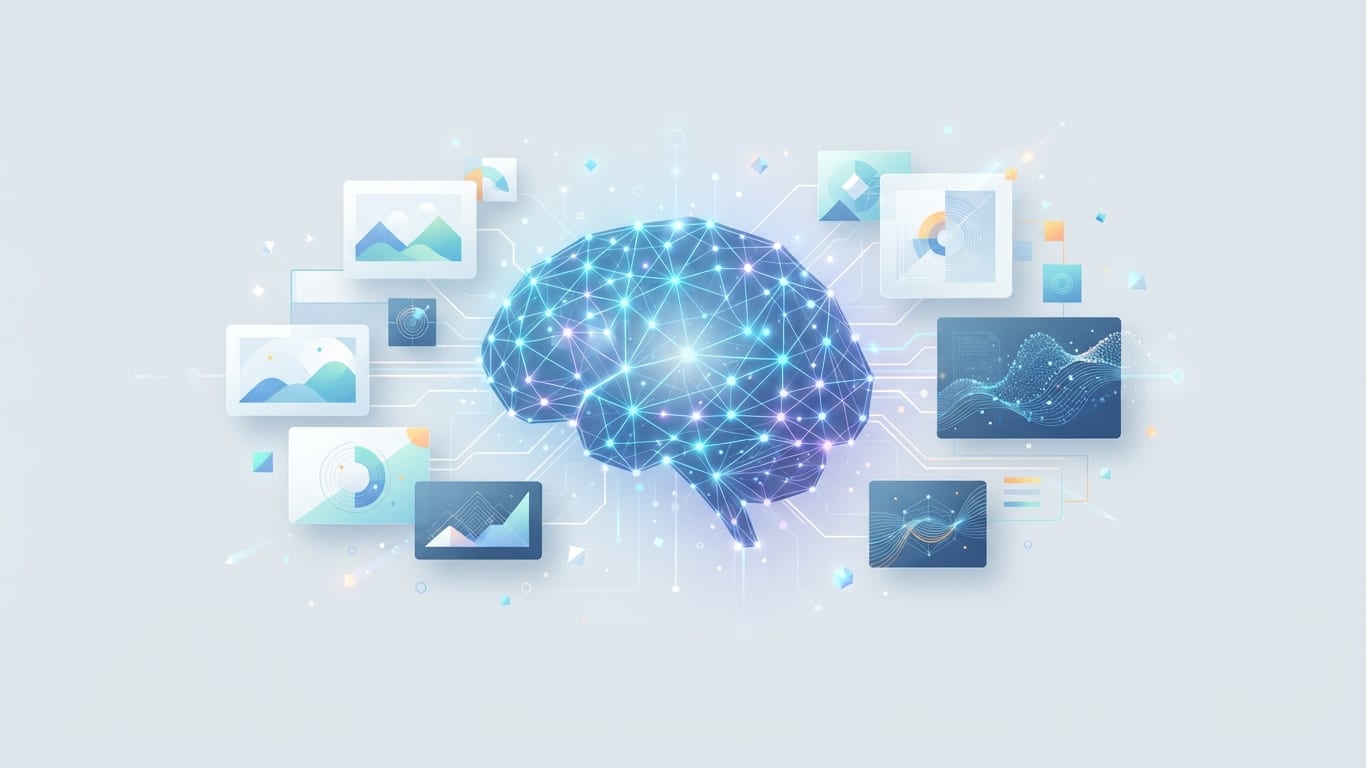
| Neural network graphic representing artificial intelligence |
To fully appreciate why this distinction matters, one must look at how digital systems have evolved from rigid, pre-programmed calculators into fluid creative partners. Traditional computer software relies entirely on explicit instructions written by human coders. If a database is asked to find a specific file, it searches for exact parameters and retrieves the stored binary data without altering its format or meaning. Generative systems, however, step outside this deterministic boundary. They do not merely retrieve information; they synthesize new artifacts from scratch. Whether painting a digital landscape, orchestrating a digital symphony, or composing an intricate legal contract, these systems simulate human creativity using advanced mathematical models. Within this sweeping technological revolution, text-based software has carved out its own specialized niche, leading to the creation of advanced natural language systems that alter how humanity communicates with machines.
Defining Generative AI: The Broad Overarching Category
To fully grasp the technological ecosystem, it is helpful to look at the broader umbrella. Generative AI is a broad category of artificial intelligence that encompasses all creative AI tools designed to produce original content across various mediums, including images, music, video, and text. Unlike traditional software that simply follows strict, pre-written rules to organize or retrieve existing data, generative systems create entirely new artifacts based on patterns learned from vast amounts of input. This capability spans multiple creative domains. For instance, text generators write essays, video generators build motion scenes, and audio tools compose tracks. As companies continuously release advanced video applications, such as those highlighted in The Impact of Google's new video model, Omni!, the boundaries of visual creation continue to expand rapidly under this expansive generative banner.
The scope of generative AI extends far beyond simple writing utilities. In the visual arts, generative adversarial networks and diffusion models allow users to input text prompts and receive stunning, photorealistic images, digital paintings, or architectural concepts within seconds. In the audio engineering space, AI tools can synthesize human singing voices, generate background scores tailored to match the emotional arc of a movie scene, or clean up noisy recordings by predicting missing audio frequencies. Furthermore, software development benefits immensely from generative coding assistants that draft entire script structures, find security flaws, or translate legacy code from one programming language to another. Because this category encompasses any system capable of synthesizing novel outputs from probabilistic distributions, it remains the defining technological frontier of our time.
Defining Large Language Models: The Text-Focused Engines
While the umbrella term covers many media types, text has its own dedicated engines. Large language models (LLMs) are a specific type of generative model engineered specifically to process, understand, and generate human-like text and language-based tasks. Well-known examples of large language models include OpenAI's GPT-4 featuring 175 billion parameters, Google’s Gemini and BERT, Anthropic's Claude, and Meta’s Llama models. These systems are built exclusively to handle semantic communication, turning human prompts into structured paragraphs, code snippets, or translated passages. Because they focus entirely on words, sentences, and syntax, they form the backbone of modern conversational software, writing assistants, and language analysis utilities used by millions of individuals and enterprises globally every single day.
The engineering focus required to build an effective text engine differs significantly from that of an image generator. While visual models must master pixel arrangements, color gradients, and spatial awareness, language models must navigate the intricate rules of human grammar, idioms, cultural contexts, and logical reasoning. A model like OpenAI's GPT-4, boasting 175 billion parameters, must maintain a coherent train of thought across thousands of words, ensuring that a story or argument written at the end of a long prompt aligns logically with the premises established at the beginning. Similarly, Meta’s open-source Llama models and Anthropic’s Claude offer developers unique pathways to harness this textual prowess, enabling specialized fine-tuning for legal, medical, and educational applications where precision in language is paramount.
The Hierarchical Relationship: Mapping LLMs Inside Generative AI
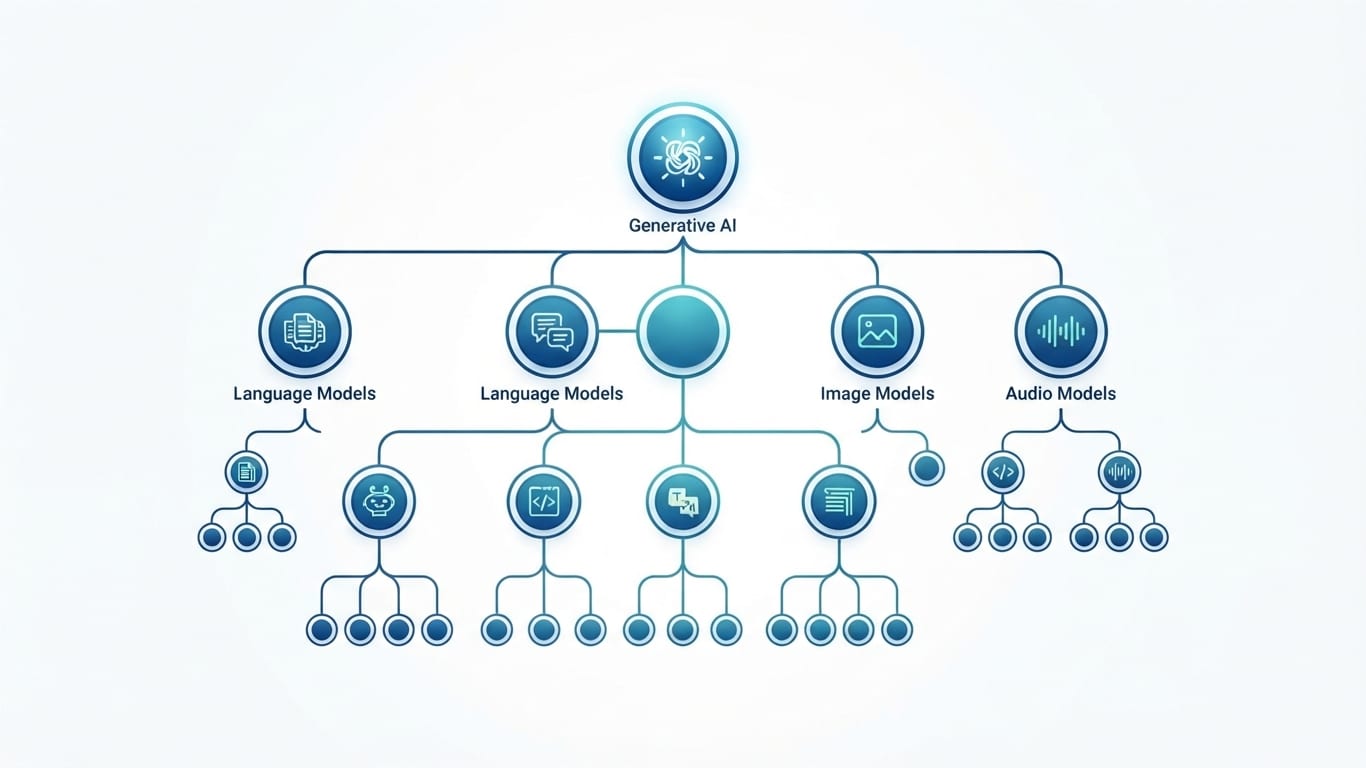
Clarifying the structure of these technologies reveals a clear relationship. Yes, large language models are a subset of generative AI; generative AI acts as the overarching category, while LLMs function as the specific engines built for text. Think of generative AI as a massive manufacturing corporation that produces various goods—furniture, electronics, and clothing. In this analogy, the large language model represents a specialized factory within that corporation that exclusively manufactures books and written documents. Every LLM is inherently a form of generative AI because it creates novel content, but not every generative AI tool is an LLM, since many focus on pixels, shapes, frequencies, and frames rather than words. This structural distinction influences how markets evaluate financial shifts, including the trends analyzed in The $1 Trillion Question Can Tech Stocks Recover from DeepSeek's Impact & How DeepSeek's AI Model Challenges US Dominance!.
Recognizing this hierarchy prevents common misconceptions in software procurement and technology journalism. When people use a text-based conversational assistant, they are interacting with both concepts simultaneously: they are utilizing generative AI as the broader method of creation, but they are specifically operating a large language model as the technical implementation. Conversely, when a digital artist uses an AI tool to render a fantasy castle, they are engaging with generative AI, but they are utilizing a diffusion model rather than an LLM. Maintaining this clarity helps engineers select the right algorithmic frameworks for specific business problems, ensuring that text-heavy tasks are routed to language-optimized transformers rather than image-rendering architectures.
 TechMediaArch.com TechMediaArch.com |
| Hierarchical diagram of generative AI and language models |
The Core Technology Architecture Behind Language Models
Beneath the surface of text generation lies a complex and sophisticated engineering framework. LLMs are built on deep learning techniques utilizing neural networks with billions or trillions of parameters, predominantly relying on the transformer architecture. During operation, an LLM breaks input text down into smaller subword units or characters called tokens. After tokenization, inputs are converted into numerical vectors known as embeddings to allow the neural network to process them mathematically. Transformer architectures use self-attention mechanisms via encoders and decoders to extract meaning, understand context, and capture complex relationships between words across an entire text sequence. This deep mathematical pipeline allows the system to comprehend nuanced prompts far better than older computing models ever could.
The journey of a single prompt through this architecture is a marvel of modern computational mathematics. When a user types a sentence into an interface, the model does not read the words the way a human does. First, the tokenization process segments the text into manageable numerical identifiers. These identifiers are then mapped into high-dimensional vector embeddings, placing words with similar meanings close to one another in a mathematical space. The self-attention mechanism then evaluates the entire sequence concurrently rather than sequentially, weighing the importance of every word relative to every other word in the prompt. For example, in the sentence "The bank of the river," the self-attention mechanism ensures the model understands that "bank" refers to a geographical feature rather than a financial institution, accurately resolving ambiguities based on surrounding context.
How Text Processing and Statistical Prediction Work
The actual mechanics of writing rely heavily on probability and statistics. LLMs function as statistical prediction engines that repeatedly forecast the most likely next word or token in a sequence based on learned patterns. Once trained, the model processes prompts dynamically via inference—generating output token by token by calculating probabilities until a complete response is formed. Models are pre-trained on massive collections of unstructured data, which include books, Wikipedia pages, research papers, and billions of web pages from repositories like Common Crawl. This massive foundational diet gives the software an expansive understanding of human phrasing, historical facts, coding languages, and cultural expressions, allowing it to predict text continuations with astonishing accuracy.
During the pre-training phase, the model acts as an advanced predictive text tool on a planetary scale, consuming vast swathes of human knowledge to learn the statistical likelihood of how sentences are constructed. It reads through billions of pages from Common Crawl, academic journals, and literary classics, adjusting its internal weights to minimize prediction errors. When inference occurs, the model takes a user prompt and calculates a probability distribution across its entire vocabulary for the very next token. By sampling from this distribution—often guided by parameters like temperature and top-p sampling—the model selects a token, appends it to the prompt, and repeats the entire calculation for the subsequent token. This autoregressive loop continues seamlessly until an end-of-sequence token is reached, resulting in a cohesive and contextually relevant paragraph.
Real-World Enterprise and Consumer Applications
Because of their robust architecture and statistical capabilities, these language engines find homes in many practical workflows. LLMs are widely implemented in AI systems for conversational chatbots, document summarization, language translation, sentiment analysis, text completion, and debugging code. Businesses utilize them to parse through endless pages of legal text, customer service teams deploy them to handle routine inquiries, and programmers rely on them to find errors in software scripts. Additionally, multimodal options expand these boundaries even further, matching the versatility found in tools described in The new AI, Aria, is a multimodal AI free to compete with big tech giants, bridging text processing with other sensory mediums seamlessly.
In the corporate sector, the deployment of large language models has fundamentally transformed productivity workflows. Enterprise legal departments now use customized LLMs to review thousands of pages of corporate contracts in minutes, highlighting clauses that deviate from standard compliance guidelines. In customer support environments, advanced chatbots powered by these text engines resolve up to eighty percent of tier-one inquiries instantly, providing accurate troubleshooting steps without requiring human intervention. Software engineering teams integrate LLM-based coding assistants directly into their integrated development environments, allowing developers to write boilerplate code, generate unit tests, and refactor messy algorithms simply by typing natural language instructions into a comment block.
Personalization, Styles, and Advanced Dialogue Capabilities
Modern language systems do more than just repeat facts; they adapt their tone to match specific human audiences. Research demonstrates that LLMs can successfully adapt and personalize dialogue responses to reflect distinct linguistic and communication styles of various generations, such as Baby Boomers, Generation X, Millennials, and Generation Z. By adjusting vocabulary, slang usage, sentence structure, and conversational pacing, the system can tailor its output to resonate with younger digital natives or older, more formal professionals alike. This high degree of behavioral flexibility transforms passive text generators into dynamic conversational partners capable of shifting their persona instantly based on context, user preferences, or targeted prompts.
This adaptive conversational capacity stems from the model's ability to recognize stylistic nuances embedded within its training data. When prompted to adopt the communication style of a specific generation, the underlying transformer network accesses vector associations related to specific slang terms, shorthand abbreviations, formal greetings, or colloquialisms. For instance, interacting with a Millennial user might elicit conversational phrasing characterized by modern workplace idioms and digital brevity, whereas communicating with a Baby Boomer might trigger more traditional sentence structures, complete capitalization, and formal sign-offs. This granular control over tone and register makes LLMs exceptionally powerful tools for marketing copywriters, educators, and customer experience managers seeking to forge genuine connections with diverse demographic groups.
FAQ
Is large language models generative AI?
Yes, large language models are a subset of generative AI; generative AI acts as the overarching category, while LLMs function as the specific engines built for text.
What large language models can AI force configure?
Large language models rely on deep learning techniques utilizing neural networks with billions or trillions of parameters, predominantly relying on the transformer architecture to configure internal weights during training and inference.
What are large language models LLMs used for in ai systems?
LLMs are widely implemented in AI systems for conversational chatbots, document summarization, language translation, sentiment analysis, text completion, and debugging code.
Can large language models personalize dialogues to generational styles?
Research demonstrates that LLMs can successfully adapt and personalize dialogue responses to reflect distinct linguistic and communication styles of various generations, such as Baby Boomers, Generation X, Millennials, and Generation Z.
How does large language models work?
LLMs function as statistical prediction engines that break input text into tokens, convert them into vector embeddings, and repeatedly forecast the most likely next word or token using self-attention mechanisms in a transformer neural network.