Introduction to Python and Its Core Purpose
If you are exploring the world of software development, you have likely wondered what is python programming used for in modern technology. Python is an open-source, high-level, general-purpose programming language created by Guido van Rossum in 1991. Since its inception, it has grown into one of the most popular and versatile tools in the software industry. At its core, Python is primarily used for data analysis, data science, machine learning, artificial intelligence, and web development. Its design philosophy prioritizes code readability and simplicity, making it accessible to newcomers while remaining powerful enough for enterprise-level applications. Whether you want to automate tedious daily workflows or build complex predictive models, Python serves as a foundational tool that bridges the gap between human intent and computer execution.
 TechMediaArch.com TechMediaArch.com |
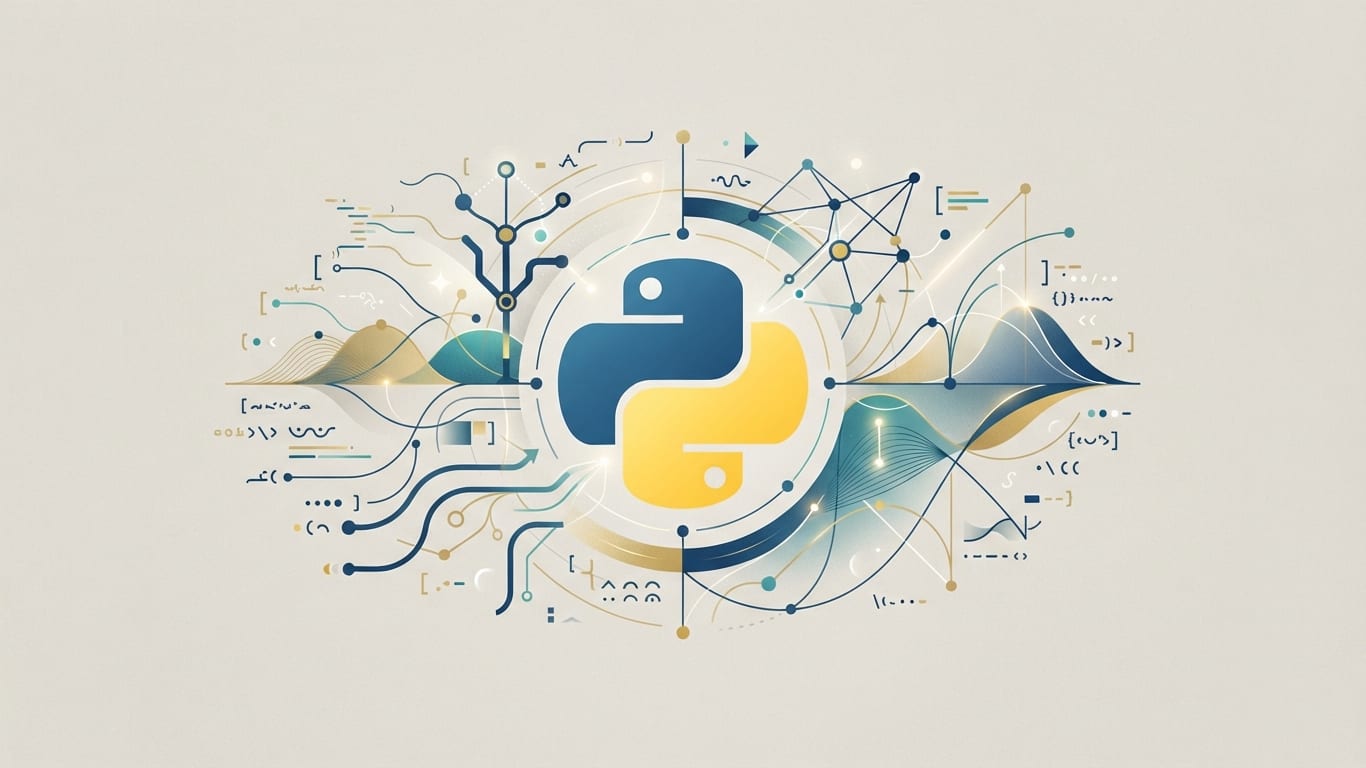
| Python programming language logo surrounded by data and code elements |
To truly appreciate the ubiquity of Python today, it helps to understand its origins under Guido van Rossum. Released in 1991, the language was engineered to address the flaws of earlier programming environments, specifically targeting code maintainability and developer productivity. Because it is an open-source project, a global community of contributors continuously refines and expands its capabilities. This collaborative ecosystem ensures that Python remains at the cutting edge of technological evolution, adapting rapidly to new paradigms like cloud computing, big data analytics, and modern web architectures without losing its foundational simplicity.
Furthermore, general-purpose programming means that Python is not restricted to a single niche or domain. While specialized languages exist exclusively for database management or styling web pages, Python spans multiple industries. You will find it deployed in financial institutions calculating risk portfolios, in biological research sequencing genetic data, in gaming studios scripting non-player character behaviors, and in embedded systems controlling physical hardware devices. This broad applicability is precisely why learning Python unlocks diverse career opportunities across the entire technology sector.
Why the Design of Python Encourages Simplicity
Understanding why python programming language is used by millions of developers worldwide begins with its unique syntax and structure. Python is widely chosen because its syntax is designed to resemble natural English, emphasizing code readability and simplicity. Unlike older languages that require complex punctuation and dense boilerplate text to perform basic functions, Python allows developers to write cleaner, more intuitive instructions. Furthermore, Python operates as an interpreted language, executing code line by line to make debugging easier while writing code. This immediate feedback loop helps learners and professionals spot errors instantly without compiling massive blocks of code before testing. Additionally, Python supports multiple programming paradigms, including object-oriented, functional, and procedural programming styles, giving developers the flexibility to solve problems using the approach that best fits their specific project requirements.
Code readability has profound economic and practical implications for software teams. In a typical software lifecycle, code is read far more often than it is written. By enforcing structural clarity—such as using white space and indentation to define code blocks rather than heavy brackets and semicolons—Python ensures that any developer can pick up another team member's code and understand its logic rapidly. This reduces onboarding time for new hires and minimizes costly maintenance errors over long project lifecycles.
The interpreted nature of Python further accelerates development velocity. In compiled languages, developers must wait through a separate translation step to convert source code into machine code before running it. With Python, an interpreter processes the source instructions on the fly. This dynamic execution environment allows for interactive testing, rapid prototyping, and immediate experimentation. Developers can execute individual lines or snippets of code inside interactive shells, verify outcomes instantly, and refine their logic on the fly. Combined with support for procedural, functional, and object-oriented paradigms, Python accommodates both quick procedural scripts and massive, highly structured object-oriented architectures within the exact same language ecosystem.
Data Science, Machine Learning, and Artificial Intelligence
When businesses look at what can python programming be used for, they frequently point to the fields of advanced data processing and predictive modeling. Python features an extensive standard library alongside a large ecosystem of third-party modules, such as NumPy, Pandas, and TensorFlow. These specialized libraries allow data scientists to clean messy datasets, perform complex mathematical computations, and train sophisticated artificial intelligence models with minimal friction. Because of these powerful capabilities, organizations rely on Python to uncover hidden market trends, automate consumer recommendations, and build cutting-edge neural networks. The language handles massive computational workloads seamlessly, making it the undisputed industry standard for anyone working in machine learning, deep learning, and statistical analysis.
The dominance of Python in data science is built on specialized third-party libraries that solve heavy computational challenges out of the box. For example, NumPy provides support for large, multi-dimensional arrays and matrices of numerical data, alongside a large collection of high-level mathematical functions to operate on these arrays. Building on top of NumPy, the Pandas library introduces high-performance, easy-to-use data structures and data analysis tools, allowing researchers to manipulate tabular data just as they would in a spreadsheet or relational database, but at scale.
When transitioning from basic data analysis into machine learning and artificial intelligence, developers turn to frameworks like TensorFlow, PyTorch, and Scikit-learn. These tools abstract away the grueling low-level mathematics required to construct neural networks, regression models, and classification algorithms. Instead of writing linear algebra equations from scratch, a data scientist can import established modules to train models that recognize images, process natural language, forecast inventory demands, or detect fraudulent transactions. This high-level abstraction empowers researchers to focus on problem-solving and architectural design rather than getting bogged down in implementation minutiae.
 TechMediaArch.com TechMediaArch.com |
| Developer working on software and machine learning projects |
Web Development and Back-End Server Operations
Beyond data analytics, Python plays a massive role in building and maintaining the digital infrastructure of the internet. Developers use Python for web development and back-end server operations utilizing frameworks like Flask and Django. These robust frameworks provide pre-built components and security features that streamline the creation of dynamic websites and web applications. Instead of writing every security protocol or database connection from scratch, developers leverage Python to handle server-side logic, route user requests, and manage database interactions efficiently. This capability allows startups and large enterprises alike to scale their web platforms rapidly while maintaining clean, maintainable codebases that are easy to update over time.
When building modern web applications, developers face numerous challenges, including user authentication, URL routing, database connection management, and protection against common cyber threats like SQL injection and cross-site scripting. Python web frameworks address these challenges directly. Django, often described as a "batteries-included" framework, provides a built-in administration panel, robust user authentication tools, an Object-Relational Mapper (ORM) for interacting with databases safely, and automatic form generation. This structural richness enables engineering teams to launch secure, fully functional web applications in a fraction of the time required by more bare-bones environments.
On the other hand, for smaller applications, micro-services, or APIs where absolute minimalism is desired, developers utilize Flask. Flask offers a lightweight, flexible approach that gives developers total control over their application architecture and component selection. Whether powering a high-throughput micro-service handling thousands of requests per second or a content-heavy enterprise web portal, Python back-end operations deliver exceptional stability, clean code readability, and seamless integration with front-end technologies like HTML, CSS, and JavaScript frameworks.
Automation and Workflow Optimization in Real Life
You do not need to build a massive software application to benefit from Python in your day-to-day routines. What is python programming used for in real life often includes powering mundane task automation that saves humans countless hours of manual labor. Python is frequently used to automate repetitive tasks and routine workflows, such as file management and data processing. For instance, a professional can write a short Python script to automatically organize hundreds of messy desktop files into proper folders, scrape pricing data from various websites, or generate standardized reports from raw spreadsheet inputs. By removing human error from repetitive tasks, Python empowers professionals across finance, marketing, and administration to focus on higher-level strategic work.
Consider the typical administrative burden faced by modern office workers: downloading attachments from emails, renaming files according to strict naming conventions, sorting them into deep directory trees, extracting key financial figures into master spreadsheets, and emailing summary reports to management. Doing this manually is tedious, exhausting, and highly prone to human error. With Python's built-in modules—such as os, shutil, and csv—an individual can write a short script that accomplishes these exact steps in less than a second.
Beyond local file management, Python excels at web scraping and data harvesting. Using libraries like BeautifulSoup or Selenium, professionals can programmatically navigate web pages, extract specific unstructured text or tabular data, and convert it into structured formats like JSON or CSV. Financial analysts track competitor pricing changes hourly, real estate agents aggregate property listings across multiple boards, and researchers collect public sentiment data from social media platforms—all powered by automated Python scripts running quietly in the background on scheduled intervals.
Enterprise Scale and Global Real-World Applications
The reliability and versatility of Python are proven by the massive global entities that rely on it for their core operations. Real-life applications of Python include powering features for major organizations like Google, NASA, Netflix, Spotify, and Wikipedia. At Netflix, Python drives the recommendation engines that suggest your next favorite television show, as well as helping manage content delivery infrastructure. NASA utilizes Python to process complex space telemetry data and support scientific research workflows. Furthermore, Python is considered portable, meaning code written for a Windows system can run on macOS or Linux without requiring immediate alterations. This cross-platform compatibility ensures that large engineering teams can collaborate seamlessly regardless of the operating systems they prefer on their local workstations.
At Google, Python has been a core server-side language since the company's earliest days. It is utilized across search engine infrastructure, internal tool development, and systems management because it enables rapid iteration and clean maintenance. Similarly, Spotify relies heavily on Python for its back-end services and data analysis pipelines, using the language to handle massive music streaming queues, track user listening habits, and build dynamic playlist generation algorithms.
Cross-platform portability is a vital asset for these large-scale organizations. Because Python code runs smoothly across Windows, macOS, Linux, and Unix operating systems without requiring core architectural rewrites, development teams do not need to worry about hardware and operating system discrepancies among their engineers or production servers. A script written, tested, and validated on a developer's local MacBook can be deployed directly onto Linux-based cloud servers (such as AWS or Google Cloud Platform) with total confidence that the execution logic will remain completely consistent.
FAQ
Is Python programming hard to learn?
Python is widely regarded as one of the easiest programming languages for beginners to learn due to its clean syntax and minimal boilerplate text. Because it closely mimics natural English, new learners can grasp fundamental programming concepts much faster than they would with more rigid or verbose languages.
Does Python programming pay well?
Python programming generally pays well, with data indicating median total pay for Python developers around $131,000 per year, depending on location and experience. Entry-level Python developer salaries typically average around $106,000 to $119,000 annually in the United States.
What can senior Python developers expect to earn?
Senior Python developers and roles at major tech companies, such as FAANG, often command salaries ranging from $136,000 to over $210,000 per year. Securing these high-paying roles typically requires combining core Python knowledge with specialized libraries, frameworks, or database languages like SQL.