Understanding Product Management and Business Development
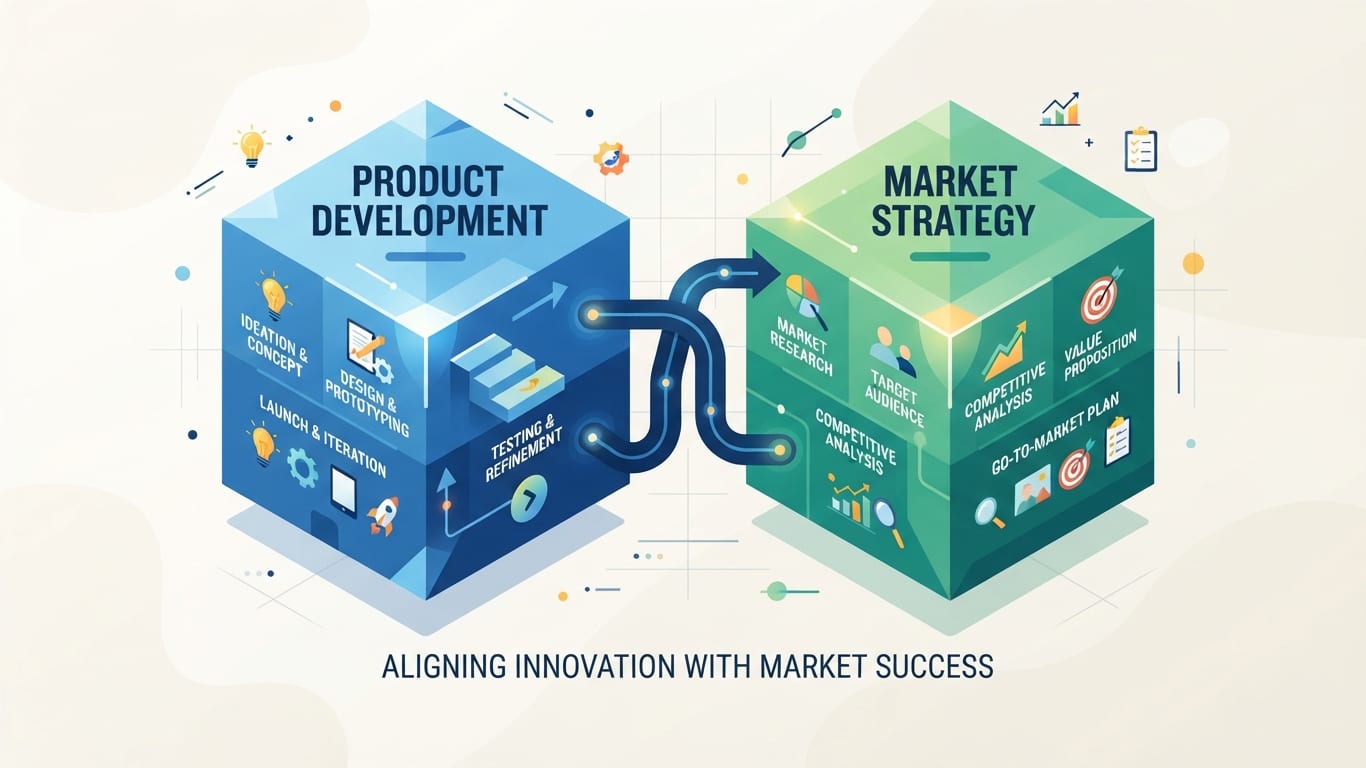
Product managers focus on the development and management of a specific product, whereas business development managers concentrate on identifying and pursuing new avenues for commercial growth, according to Vlad Selitbovskyi. These two corporate functions drive tech enterprises forward through entirely separate operational mechanisms.
 TechMediaArch.com |
| Product manager designing application features on a laptop |
Understanding these distinct tracks helps organizations allocate resources efficiently between internal creation and external market expansion. Commercial growth teams evaluate external opportunities to secure long-term revenue streams. Product teams oversee the actual creation of value within the platform boundaries.
Commercial Growth Versus Product Lifecycle Focus
Business development professionals operate primarily around relationships and external strategies, whereas product managers act as objective scientists striving to figure out the right features and capabilities to build internally, as detailed by Forbes. This external orientation means commercial growth teams spend their days negotiating partnerships and scouting new markets.
According to Zippia, the core skill set for a business development manager frequently highlights customer service and CRM, while a product manager's essential skills emphasize product strategy and QA. Enterprise software firms rely on this division of labor to ensure market expansion happens concurrently with platform stability.
While business development experts build joint ventures and secure new distribution channels, product professionals refine the user experience based on incoming market signals. This structural separation prevents teams from losing focus on either immediate sales targets or long-term product viability.
Commercial teams bring new revenue opportunities to the table, and product teams evaluate whether those opportunities fit the core roadmap.
The Responsibilities of Product Management in Tech
Atlassian notes that product management is a role responsible for a product across its entire lifecycle, encompassing the definition of a product vision, setting product strategy, and delivering new functionality that meets user needs and business goals.
Tech firms often describe these practitioners as the mini-CEO of the product, operating at the intersection of business, technology, and user experience, according to Hiperpool.
Merrimack College cites Marty Cagan, who defines product management as the discipline of discovering a product that is valuable, usable, and feasible while acting as a conductor who guides the overall product vision without directly playing every instrument.
Understanding what is product management in tech requires looking at how teams build software applications. Product managers focus on product strategy and customer alignment, whereas software engineers focus primarily on technical implementation, coding, and debugging, according to LaunchNotes.
This oversight demands continuous balancing of technical constraints against business objectives. Product professionals must evaluate user feedback and translate those insights into concrete feature requirements. They shield engineering teams from shifting external demands while maintaining alignment with overall company goals.
How Product Management Differs From Software Engineering
Software engineers tend to work mainly within their own teams to program and test robust code solutions, whereas product managers collaborate across many different departments to align diverse stakeholders, according to Wrike.
Reddit observes that software engineering work is highly individual-focused and concrete with tangible tasks completed in sprints, whereas product management work is ambiguous, highly variable, and heavily reliant on cross-functional alignment.
A common point of confusion among job seekers involves the technical requirements of the role. Udacity points out that product management does not universally require writing application code, as most product managers do not write production code, but nearly all effective PMs benefit from technical literacy and system comprehension.
Dovetail reports that while product managers can rely on technical support from development teams, having coding knowledge or technical skills simplifies the job, aids in setting realistic timelines, and helps bridge communication gaps.
GeeksforGeeks adds that understanding coding fundamentals allows a product manager to communicate product capabilities and limitations more precisely, fostering improved cooperation between technical and non-technical stakeholders.
Engineering professionals focus heavily on architectural integrity, database performance, and clean codebases. Product leaders focus on market timing, feature prioritization, and customer value realization. Both disciplines are essential for releasing functional software, yet their day-to-day execution requires entirely different mindsets.
 TechMediaArch.com |
| Business development professionals shaking hands on a partnership |
Distinguishing Product Management From Business Analysis
Yardstick states that product managers focus on defining product vision, strategy, and overall lifecycle management, whereas business analysts concentrate on business processes and systems improvement. These analytical roles operate behind the scenes to optimize existing corporate workflows rather than designing new market offerings.
According to Indeed, business analysts rarely interact directly with customers and instead work with internal colleagues like leadership, developers, and product managers, whereas product managers often work directly with external clients especially in B2B contexts.
GeeksforGeeks notes that business analysts dive deep into the micro-details to ensure everyone understands what needs to be built and how to execute it, complementing the higher-level focus of product managers.
Business analysts evaluate operational metrics and document system requirements to streamline internal procedures. Product managers take a broader view of market demand and lifecycle milestones. This partnership ensures that internal systems support the overarching product strategy without creating operational bottlenecks.
Preparing for Product Management Interviews
Candidates preparing for job evaluations often struggle with standard behavioral inquiries. DEV Community emphasizes that an effective why product manager interview answer requires going beyond generic statements to demonstrate genuine passion for solving complex problems, deep awareness of the role's facets, and alignment with user-centric solutions.
Bryce York advises that successful PM interview candidates demonstrate intellectual curiosity by asking probing questions about the business, product operations, and team structure rather than accepting surface-level answers.
Intuit Blog recommends that when answering why you want a product manager job during an interview, you should thoroughly research the company's objectives and tie your response to long-term career progression and core responsibilities like strategic planning and team leadership.
Interviewers look for candidates who can navigate ambiguity and coordinate cross-functional teams effectively. Demonstrating a clear understanding of user needs helps set top applicants apart from the competition.
Prospective hires should prepare specific examples of past problem-solving scenarios to validate their strategic capabilities.
Core Distinctions Between Technical Roles and Commercial Functions
Here are the core structural differences between these technical and commercial disciplines:
- Product managers define overall product vision and lifecycle strategy.
- Software engineers focus on writing code and technical debugging.
- Business analysts optimize internal systems and workflows.
- Business development managers secure external partnerships and revenue growth.
Essential Skills Across Enterprise Functions
These specialized proficiencies define each specific track:
- Product strategy and quality assurance define the product track.
- CRM platforms and customer service drive commercial growth.
- System comprehension and technical literacy support cross-functional alignment.
- Sprint execution and individual programming anchor engineering tasks.
For a broader perspective on how product roles intersect with promotional messaging, explore our breakdown on product management vs marketing.
FAQ
What is the difference between product management and business development?
Product managers focus on the development and management of a specific product, whereas business development managers concentrate on identifying and pursuing new avenues for commercial growth. Business development professionals operate primarily around relationships and external strategies, whereas product managers act as objective scientists striving to figure out the right features and capabilities to build internally.
What is the difference between product management and business analyst?
Product managers focus on defining product vision, strategy, and overall lifecycle management, whereas business analysts concentrate on business processes and systems improvement. Furthermore, business analysts rarely interact directly with customers and instead work with internal colleagues, whereas product managers often work directly with external clients.
What is the difference between product management and development?
Product managers focus on product strategy and customer alignment across the entire product lifecycle, whereas software engineers focus primarily on technical implementation, coding, and debugging. Software engineering work is highly individual-focused and concrete with tangible tasks completed in sprints, whereas product management work is ambiguous and relies on cross-functional alignment.
Does product management require coding?
Product management does not universally require writing application code, as most product managers do not write production code. However, nearly all effective product managers benefit from technical literacy, system comprehension, and coding fundamentals to communicate product capabilities and limitations more precisely.
How to craft a compelling why product manager interview answer?
An effective interview answer requires going beyond generic statements to demonstrate genuine passion for solving complex problems and user-centric solutions. Candidates should thoroughly research the hiring company's objectives and tie their response to long-term career progression, strategic planning, and team leadership.
Related reading
- Product Management vs Product Marketing: Key Differences
- What Does Product Management Involve? Core Roles & Skills