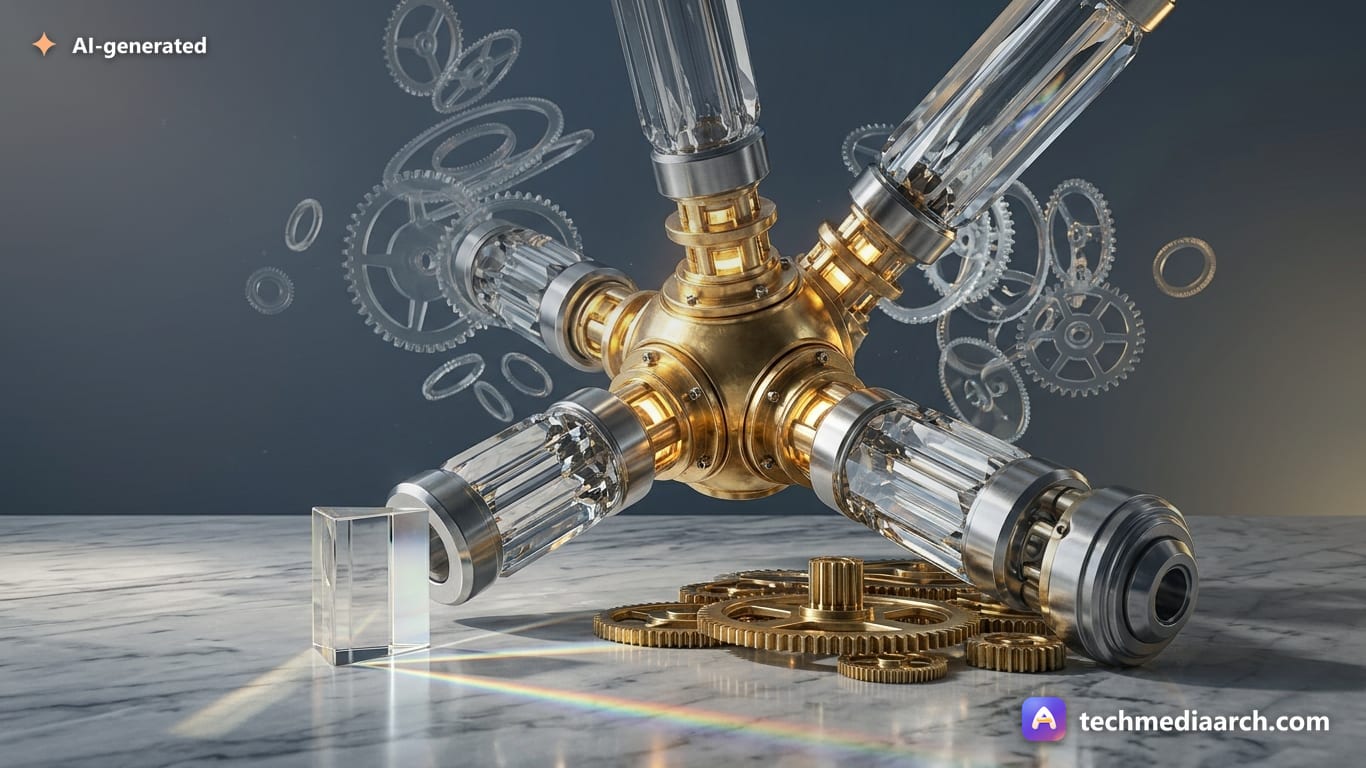

 |
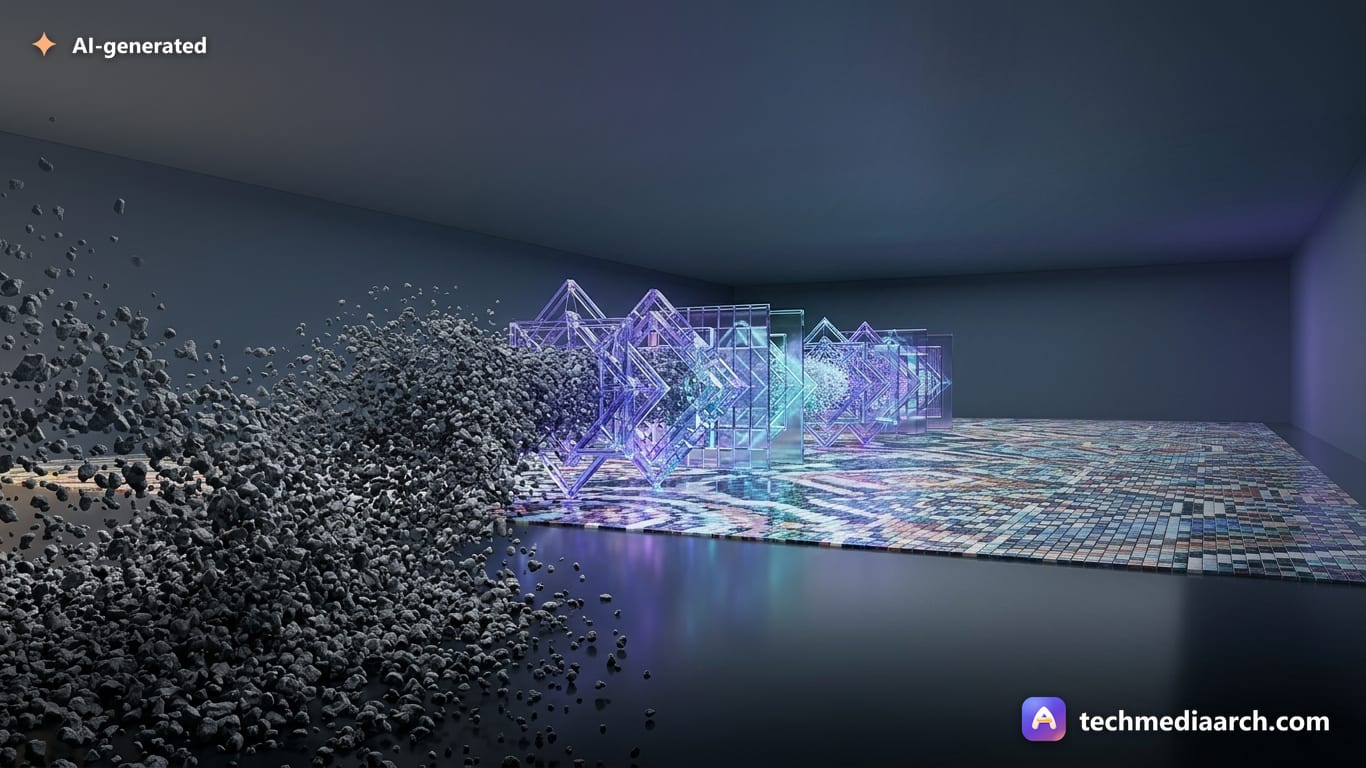
| Abstract visualization of noise turning into structured mosaic through crystal lattices. |
The Core Purpose and Architectures of Generative AI Systems
Generative artificial intelligence is designed to synthesize entirely new data instances that mimic real-world distributions. When generating imagery, these systems estimate mathematical probability distributions across millions of pixel combinations to construct original visuals.
Generative image creation relies on several core neural network architectures, according to IBM. These foundational frameworks include Variational Autoencoders, Generative Adversarial Networks, autoregressive models, and diffusion models.
Traditional Generative Adversarial Networks pit a generator network against an opposing discriminator network in an adversarial training loop. In contrast, diffusion models operate as likelihood-based systems trained end-to-end using a single loss function.
Early generative frameworks faced technical stability issues during long training runs. Research published by Huggingface indicates that traditional adversarial networks are prone to mode collapse, where the system fails to represent the full variety of training data and outputs repetitive concepts.
Diffusion models resolve this limitation by delivering far more stable training conditions alongside higher sample diversity. Understanding these underlying structural differences helps explain the rapid evolution detailed in Understanding Large Language Models vs Generative AI.
How Diffusion Models Build Images from Noise
Modern image synthesis builds heavily upon principles adapted from non-equilibrium thermodynamics. Historical papers hosted by Arxiv show that early diffusion frameworks established image generation by systematically destroying image structure and learning a reverse restoration process.
The forward diffusion phase operates by gradually destroying raw data patterns over fixed sequence timesteps. Standard Gaussian noise is added iteratively across a sequence of timesteps until the original image degrades into complete, isotropic Gaussian static.
Every step of this forward degradation follows precise mathematical boundaries. A technical analysis on the Blog by Kemal Erdem notes that the forward step adds small increments of noise governed by a predefined variance schedule across each timestep.
Research from Huggingface confirms that diffusion models define a Markov chain of steps, meaning each intermediate state depends strictly on the immediately preceding timestep.
The neural network learns image creation by running this entire mechanism backwards. During reverse diffusion, the trained model inspects a noisy image tensor at a given timestep, predicts the exact noise added, and subtracts it to reveal clean visual structure.
Inside the Generative AI Image Generation Process
Converting a text description into a rendered visual requires coordination across multiple neural components. The process transforms human language into mathematical vectors that direct structural image generation inside specialized network layers.
Modern diffusion engines split image creation into a structured sequential workflow. The generative process relies on four distinct technical phases to construct visuals from prompts:
- Text encoding converts user text prompts into dense numerical embeddings.
- Latent compression reduces high-resolution visual data into lower-dimensional tensors.
- Iterative denoising removes predicted static inside latent space guided by prompt conditions.
- Latent decoding translates finished lower-dimensional vectors back into visible pixel grids.
Executing diffusion directly on raw high-resolution pixel arrays requires prohibitive computational memory. Latent Diffusion Models solve this bottleneck by running iterative denoising inside a compressed, lower-dimensional space, according to Huggingface.
This architectural split relies heavily on specialized encoder networks. Technical breakdowns published by Maartengrootendorst show that a Variational Autoencoder compresses pixel images into latent space tensors before diffusion, while a matching decoder converts the final denoised tensor back into pixels.
I actually feature visuals created by modern models across my own websites, even though I maintain a cautious mindset toward automated software. Getting a clear view of how these underlying phases fit together helps turn passive doubt into practical understanding. Staying curious about the visual creation pipeline is always better than simply fearing where the industry is heading.
Text Condition Encoders and Guidance Mechanisms
Text prompts guide image synthesis by injecting semantic intent into the denoising network. Natural language phrases are processed by pre-trained language encoders like CLIP or T5 to create numerical embeddings that align concepts with visual elements.
Scaling language models produces direct improvements in downstream image quality. Research from Imagen highlights that expanding the parameter size of the text-encoding language model improves image fidelity and prompt alignment more effectively than expanding the image diffusion model itself.
Cross-attention layers within U-Net architectures inject text embeddings directly into the latent space, steering the model to eliminate noise patterns that mismatch the prompt. Guidance mechanisms like Classifier-Free Guidance adjust how strongly the conditional prompt directs the denoising trajectory relative to unconditioned generation.
Generative systems learn broader conceptual connections rather than saving exact visual templates. Denoising models learn a smoothed mathematical score function during training, enabling them to creatively interpolate between training points on a data manifold.
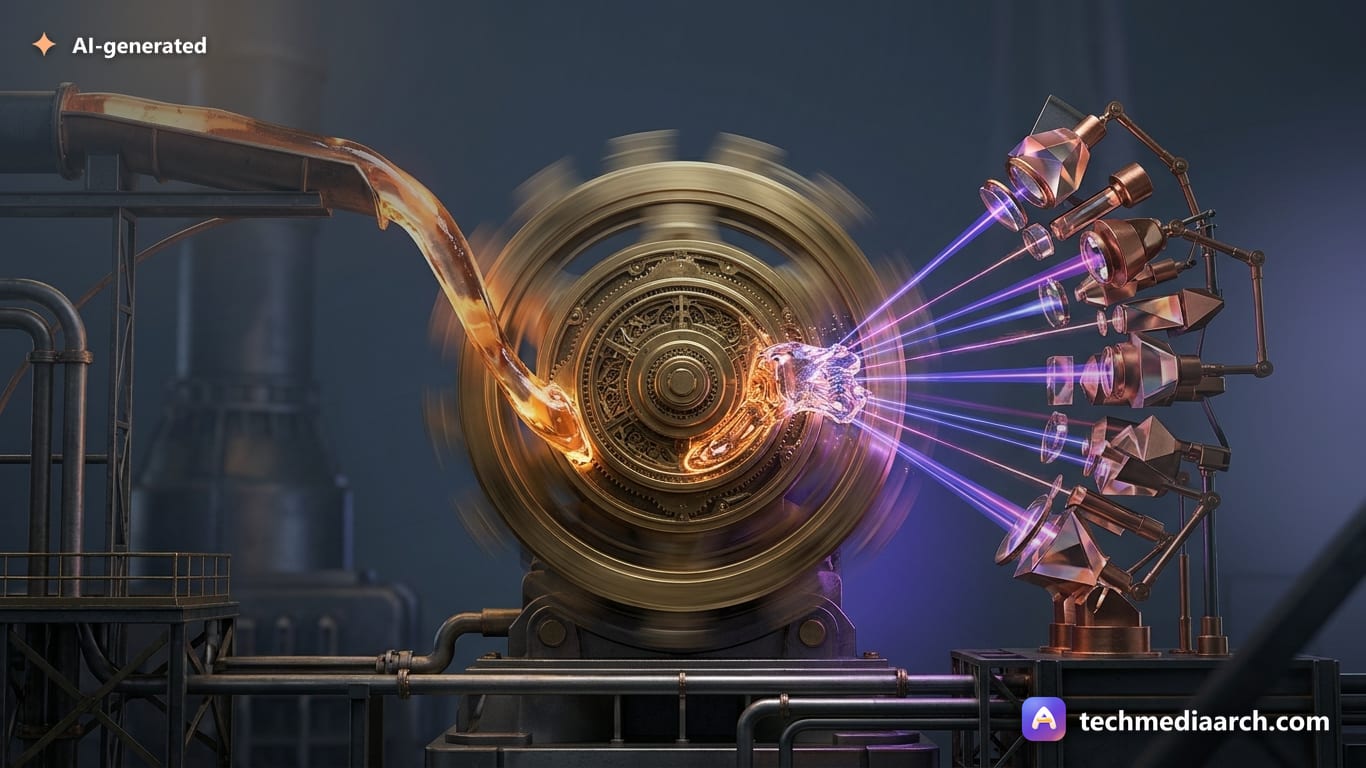 |
| A mechanical forge refining molten glass using copper prisms and light beams. |
Evaluating Current Image Generation Software and Architectures
Early automated image models relied heavily on sequential token prediction engines. Historical documentation from OpenAI notes that DALL-E 1 combined discrete autoencoders with autoregressive transformers before subsequent system designs transitioned to diffusion pipelines.
To improve prompt accuracy in later releases like DALL-E 3, developers generated detailed synthetic captions for training datasets using custom captioner models. This synthetic annotation allowed image generators to process highly complex multi-subject instructions reliably.
Newer native architectures merge text parsing and image synthesis into unified models. Native image generation in OpenAI’s GPT-4o embeds image synthesis directly into an omnimodal transformer capable of processing text and visual data simultaneously.
The NVIDIA Technical Blog reports that formulation of diffusion as continuous Ordinary Differential Equations demonstrates that model performance scales consistently alongside parameter expansion, as seen in systems detailed in Viral Flux AI Images Leave the Internet Baffled and Terrified.
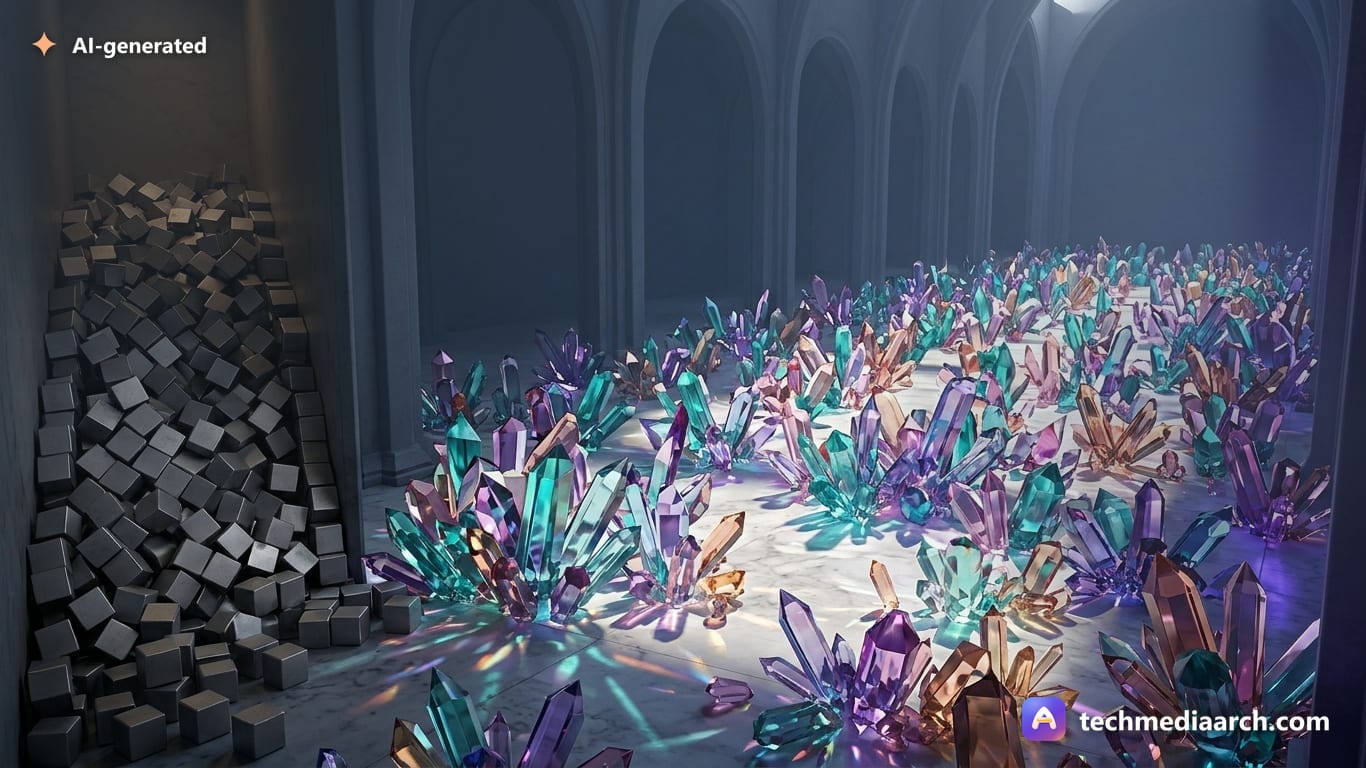 |
| Geometric iron cubes contrasting with a wide array of colorful glass crystals. |
Optimizing Efficiency for High-Resolution and On-Device Synthesis
Running multi-step diffusion networks at high resolutions introduces substantial computational challenges. Engineers use specialized sampling algorithms, cascading pipelines, and model weight averaging to accelerate processing speeds.
Applying Exponential Moving Average across model weights during extended training prevents performance degradation caused by un-averaged, fresh training weights, according to the NVIDIA Technical Blog.
Standard iterative sampling can require dozens of evaluation steps per generated frame. Deterministic frameworks like Denoising Diffusion Implicit Models model the reverse path as a continuous differential equation, generating images in significantly fewer steps than classic sampling.
Producing extremely detailed images often requires multi-stage network pipelines. Generative software designs frequently use cascaded diffusion models, which generate a low-resolution base canvas first before applying super-resolution models to upsample fine details.
Optimizing these processes enables modern creative media applications, including workflows featured in How Can You Create Movies With a Free AI Workflow?. These optimization strategies allow complex models to run efficiently on varied computing infrastructure:
- Single-step sampling cuts total inference latency down to fractions of a second.
- Latent space operations minimize hardware memory bandwidth consumption during generation.
- Super-resolution cascades preserve sharp image details without blowing up primary model size.
- Quantized parameter weights allow modern generative models to fit onto mobile hardware chips.
Mobile device hardware now supports real-time image synthesis directly on commercial processors. On-device systems like MobileDiffusion achieve sub-second 512x512 image generation on smartphones by pairing streamlined latent diffusion networks with single-step DiffusionGAN sampling.
Workplace Integration and Technical Skills Acquisition
Video production pipelines and animation studios increasingly embed generative engines into existing post-production software. Similar technical integrations appear across video models detailed in The Impact of Google's new video model, Omni!, as well as creative automation workflows discussed in How Do You Create AI Animations for YouTube Videos?.
Software engineers and media technical directors focus heavily on parameter-efficient fine-tuning frameworks like Low-Rank Adaptation (LoRA) to adapt base diffusion platforms to targeted brand aesthetics.
Bringing new software into professional environments can feel overwhelming, but attempting to ignore these tools gets us nowhere. Gaining hands-on familiarity takes steady practice rather than relying on quick shortcuts. Building solid technical skills ensures you remain confident as digital workflows continue to change.
FAQ
What is generative AI designed to do?
Generative AI is designed to analyze statistical patterns within existing training datasets to create brand-new content. In image generation, these systems construct realistic, original visuals by learning the complex underlying mathematical probability distributions of light, color, texture, and geometry.
What is the best generative AI for images?
The optimal generative AI platform depends heavily on specific application requirements and workflow constraints. Open-source Latent Diffusion Models excel when deep customization and local execution are required, while commercial omnimodal models offer superior prompt adherence and multi-subject composition out of the box.
Should I learn generative AI?
Learning generative AI provides substantial career benefits for developers, digital artists, technical managers, and content creators. Understanding how prompt conditioning, parameter fine-tuning, and neural architectures operate helps technical professionals integrate automated synthesis pipelines into modern industrial workflows.
How long does it take to learn generative AI?
Grasping fundamental concepts like text-to-image prompting and basic software interfaces takes only a few days of hands-on practice. However, mastering model fine-tuning, python framework integration, and network architecture design typically requires three to six months of focused technical study.
What is the best way to learn generative AI?
The most practical learning path combines foundational study of deep learning principles with direct practical experimentation. Building custom open-source fine-tuning workflows, studying technical documentation from leading AI research laboratories, and experimenting with latent space configurations offer the fastest skill growth.
Sources
- Diffusion Models
- What are Diffusion Models? | IBM
- DALL·E 2 | OpenAI
- Imagen: Text-to-Image Diffusion Models
- Rethinking How to Train Diffusion Models | NVIDIA Technical Blog
- Step by Step visual introduction to Diffusion Models. - Blog by Kemal Erdem
- [2006.11239] Denoising Diffusion Probabilistic Models
- A Visual Guide to Multimodal Generation