Introduction to Payment Processing Systems
Payment processing refers to the system that allows digital transactions to occur between a consumer's bank and a merchant, according to Adobe for Business. Solidgate defines payment processing as the specific system that authorizes and settles electronic transactions between a buyer's bank and a merchant's account.
 TechMediaArch.com |
| Digital credit card transaction flow illustration |
Electronic Payments notes that this infrastructure encompasses non-cash transactions including credit cards, debit cards, digital wallets like Apple Pay, and alternative methods such as ACH or Buy Now Pay Later.
As explored in Decoding the Power of Fintech: What Fintech Companies Mean for Banks, Business, and the Future, these digital layers sit on top of legacy financial networks to handle modern commerce.
The Mechanics of Transaction Authorization
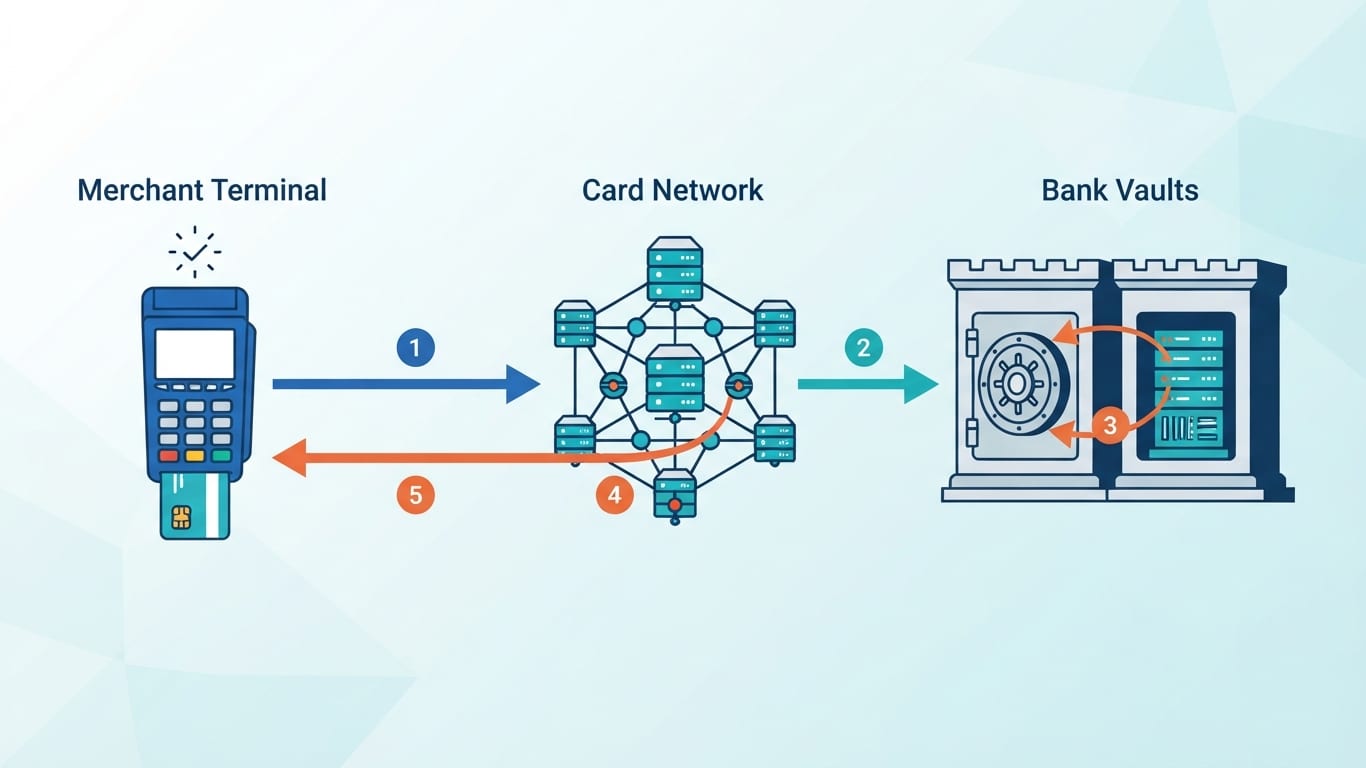
Payment processors operate on behalf of merchants by managing the payment process and transmitting transaction data between merchants, banks, and card networks, as reported by CO- by US Chamber of Commerce. eHopper POS adds that payment processors act as the mediator between the merchant and financial institutions to confirm and authorize customer transactions.
Once a transaction is successfully authorized, Worldpay explains that payment processors coordinate the transfer of funds from the customer's issuing bank to the merchant's acquiring bank. This entire sequence happens in seconds across multiple backend networks before the point-of-sale terminal prints a receipt.
These communication protocols protect merchants from accepting fraudulent cards or overdrawn bank accounts.
Understanding Processing Fees and Direct Costs
Payment processing fees are direct charges levied on merchants for processing customer credit card and online payments, as stated by the Corporate Finance Institute. Worldpay calculates that standard fees are typically structured as a percentage of each transaction combined with a flat fee, usually ranging from 1.3% to 3.5%.
Solidgate details that total processing fees are formulated by adding together interchange fees, scheme or assessment fees, and the specific processor markup. Bank of America notes that these charges may present themselves as per-transaction percentages or fixed costs, such as a flat 30 cents per transaction.
Merchants must account for these variable overhead expenses when pricing their physical goods or digital services.
How Processing Companies Generate Revenue
Payment processing companies generate revenue by adding a markup fee on top of base pass-through costs, according to Akurateco. Tribe Payments states that processors and acquirers make money by taking a slice of every transaction through a combination of a percentage fee and a flat fee, such as 35p plus 2.9%.
Alphapoint reports that processors earn revenue by retaining a margin above the baseline interchange rate that they remit directly to card issuers. Helcim outlines that credit card processors structure their profit margins through flat-rate pricing, subscription fees, equipment leasing fees, and markups added over interchange and assessment rates.
This commercial model mirrors broader trends analyzed in How Fintech Companies Make Money: A Complete Business Model Guide, highlighting the profitability of transaction routing.
 TechMediaArch.com |
| Step-by-step payment authorization network diagram |
Selecting the Best Payment Processing Platform
Finix highlights Finix, Square, Stripe, Helcim, and PayPal as leading payment processors for small businesses, where selection depends heavily on transaction volume and growth stage.
CO- by US Chamber of Commerce cites Square Payments as a top choice for small retail stores, coffee shops, and food trucks, carrying standard pricing of 2.6% plus 15 cents for in-person transactions and 3.3% plus 30 cents for online sales as of August 2026.
GoCardless recognizes PayPal as one of the best processing options for small businesses dealing with lower transaction volumes due to its user-friendly interface and widespread international acceptance.
Choosing the correct gateway often dictates how businesses navigate the distinctions outlined in Fintech vs Digital Banking: Understanding the Key Differences, particularly when integrating software tools with banking ledgers.
Troubleshooting Stuck Transactions in Google Pay
Google Pay Help advises that users experiencing a stuck processing payment on Google Pay should verify they have a stable internet connection. To troubleshoot a processing transaction in Google Pay, users must confirm that they have a valid, active bank account properly linked to the app before attempting further actions.
Google Pay troubleshooting guidelines recommend taking specific steps when payments stall unexpectedly:
- Contact your financial institution directly to check for temporary transaction blocks or server issues.
- Confirm whether the intended recipient also maintains a valid bank account linked to their profile.
- Wait out the standard processing window before escalating an issue, as merchant payments can take up to three business days to completely process according to Razorpay.
- Avoid repeating a stuck transaction because the original payment may still clear, resulting in accidental double payment as warned in a YouTube tutorial by Jane Sheeba.
Managing Delayed Transfers and UPI States
Quora notes that once a UPI PIN is entered and a Google Pay transaction enters a processing state, the user loses direct control and should wait up to 24 hours for either success or an automatic failure refund.
Attempting to force a retry during this window creates reconciliation errors for the underlying acquiring bank and disrupts automated ledger updates.
Merchants and consumers alike must navigate these multi-day clearing cycles while funds move between issuing banks and acquiring networks. Understanding these backend verification stages helps prevent premature chargebacks and accidental duplicate transfers during periods of heavy network congestion.
FAQ
What does payment processing mean?
Payment processing refers to the system that allows digital transactions to occur between a consumer's bank and a merchant. It encompasses non-cash transactions including credit cards, debit cards, digital wallets, and alternative methods like ACH or Buy Now Pay Later.
How do payment processing companies make money?
Payment processing companies make money by taking a slice of every transaction through a combination of a percentage fee and a flat fee. They achieve this by adding a markup fee on top of base pass-through costs and retaining a margin above the baseline interchange rate.
What are payment processing fees?
Payment processing fees are direct charges levied on merchants for processing customer credit card and online payments. These total fees are formulated by adding together interchange fees, scheme or assessment fees, and the specific processor markup.
What is the best payment processing company?
The best payment processing company depends heavily on transaction volume and growth stage, with leading options including Finix, Square, Stripe, Helcim, and PayPal. Square is often cited as a top choice for physical retail, while PayPal excels for lower volume small businesses.
What to do when payment is processing in gpay?
When a payment is processing in Google Pay, users should verify their internet connection and confirm their bank account is active. Quora notes users should wait up to 24 hours for success or an automatic refund, and avoid repeating the transaction to prevent accidental double payments.