Introduction to Bitcoin Mining
Bitcoin mining is the underlying process by which new bitcoins are created and the network is secured, according to Ledger. It serves as the fundamental mechanism that keeps the entire digital currency ecosystem operational.
 TechMediaArch.com TechMediaArch.com |
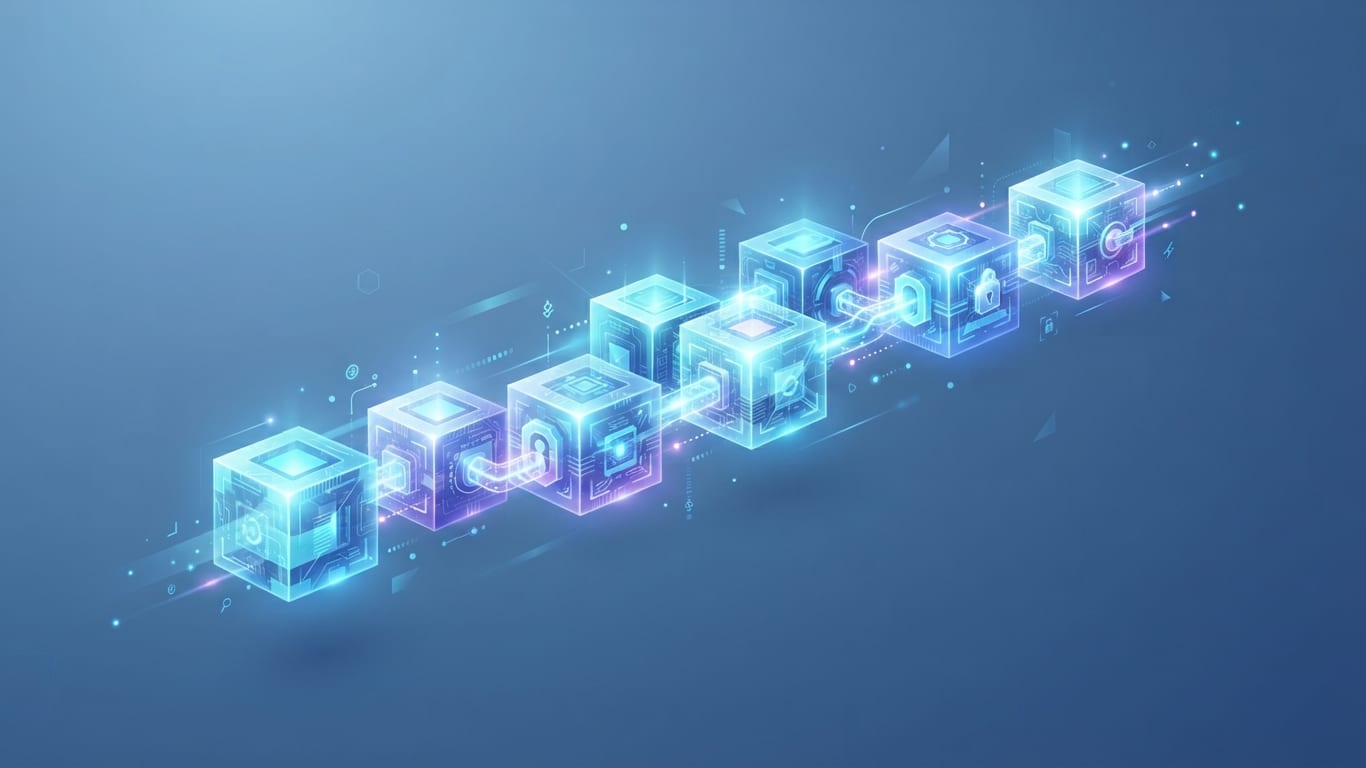
| Digital blocks connecting in a secure blockchain network |
Kiplinger notes that Bitcoin is a digital cryptocurrency held in the cloud and operated on an immutable chain of information blocks called a blockchain.
Because the network lacks a central bank, this automated process acts as the digital issuance system for new coins. Every time a block is processed, the system distributes newly minted currency to the operators who performed the computational work.
The Mechanics of Proof of Work
Mining operates as a decentralized Proof of Work consensus mechanism that reaches agreement on the true state of the blockchain without any central authority, as Ledger explains. This system prevents double-spending and fraud without needing a traditional bank.
Fidelity Investments points out that each block on the blockchain contains an encrypted mathematical puzzle that competing computers attempt to solve using trial and error. To understand how bitcoin works, miners look at this puzzle-solving process as the core engine driving transaction verification.
Fidelity Investments also details how miners verify transactions and ensure they are legitimate within minutes, eliminating the multi-day processing times typical of traditional banking systems.
Every single transaction initiated by users gets grouped together into a pending list before miners bundle them into a proposed block. The cryptographic puzzle forces computers to test millions of random number combinations per second until a valid solution is discovered.
Once a machine finds the correct output, it broadcasts the solution to the rest of the decentralized network for validation. Other nodes quickly check the math, confirm the block's legitimacy, and append it permanently to the existing public ledger.
Block Rewards and Halving Events
CoinShares reports that Bitcoin mining revenue consists of two main components:
- Newly issued block rewards
- User-paid transaction fees
- Miners rely on these incentives to cover the substantial electricity and hardware costs associated with network participation.
According to CoinShares, the block reward started at 50 BTC per block when Bitcoin launched and halves roughly every four years. This programmed scarcity ensures that the total supply of Bitcoin will eventually cap at 21 million coins.
CoinShares observes that following the most recent network halving event, the block reward stands at 3.125 BTC per block. This reduction directly impacts how much does bitcoin mining make for operators across the globe.
Transaction fees add an extra layer of compensation for miners who choose to prioritize transfers offering higher financial incentives. As the block reward continues to shrink over successive halvings, these user fees will eventually become the primary driver of miner revenue.
The predictable halving schedule eliminates arbitrary monetary policy decisions by human authorities. Market participants can accurately project the exact rate of future coin issuance decades in advance.
Hardware Evolution and Industrialization
In Bitcoin's early years, anyone with a standard home computer could participate in mining, as Coinbase highlights. Back then, hobbyists could mine coins in their bedrooms without specialized equipment.
Coinbase documents that due to exponential growth in mining difficulty as more participants joined the network over a 15-year period, the computing power required to mine Bitcoin grew significantly higher than when the first blocks were minted in 2009. This technological race left standard home computers obsolete for the task.
Freeman Law states that Application-Specific Integrated Circuit miners are devices specifically designed to mine cryptocurrencies, allowing them to produce more output than standard graphics processing units. These powerful ASIC machines now dominate the entire industrial landscape.
According to Coinbase, virtually all modern mining is conducted by specialized commercial companies or collaborative groups pooling their resources rather than solo hobbyists. This shift has raised questions about whether bitcoin mining is profitable for independent operators without massive capital.
Modern warehouse facilities house thousands of ASIC rigs running continuously while drawing massive amounts of electrical power. Advanced cooling systems are mandatory to prevent these high-density processors from overheating during continuous trial-and-error calculations.
 TechMediaArch.com TechMediaArch.com |
| Computer processors solving cryptographic math puzzles |
Mining Pools and Cloud Operations
Freeman Law explains how mining pool participation operates:
- Mining pools enable individual miners to combine their computational resources
- This increases their chances of finding blocks
- Rewards are distributed in proportion to each participant's contributed power
- Without joining these pools, smaller participants would rarely earn payouts.
Cloud mining allows individual retail miners to rent mining rigs and leverage the computational power of major corporations and dedicated crypto-mining facilities, according to Freeman Law. This alternative lets users participate without buying physical hardware.
Corporate expansion in this sector continues to make headlines, as seen in Metaplanet Secures $61 Million to Expand Bitcoin Holdings, Following MicroStrategy's Footsteps. Companies frequently adjust their financial models when market conditions change, similar to how Strategy likely to sell bitcoin to cover STRC dividends highlights corporate treasury management.
Understanding digital assets also involves exploring broader topics, such as the Difference Between Stablecoins and Cryptocurrency Explained.
Participating in a pool smooths out the variance in income for operators who would otherwise face long periods without solving a block independently. Pool operators charge a small administrative fee in exchange for aggregating hash rate and distributing steady fractional payouts.
Cloud contracts remove the logistical burden of noise, heat, and equipment maintenance from the end user. However, investors must evaluate cloud providers carefully to ensure the rental agreements remain profitable after service fees are deducted.
Network Difficulty Adjustments
Fidelity Investments notes that mining difficulty automatically adjusts higher or lower to maintain a specified block time, regulating how long it takes miners to solve cryptographic puzzles. This self-regulating code ensures that new blocks are found approximately every ten minutes regardless of how many machines join or leave the network.
When computing power surges, the puzzle difficulty increases to keep block creation steady. Conversely, if miners disconnect their machines, the network eases the puzzle requirements.
The code recalibrates this difficulty parameter every 2016 blocks, which typically spans a two-week period. This mathematical feedback loop prevents blocks from being generated too rapidly when powerful hardware upgrades are deployed.
Maintaining a predictable issuance rate protects the network from inflation shocks and preserves the long-term economic model of the digital asset. Without this dynamic adjustment feature, sudden influxes of new hardware would exhaust the total supply cap prematurely.
Security and the 51% Attack
Ledger warns that to tamper with the blockchain or reverse confirmed transactions, an attacker would need to control more than 50% of the network's total computing power, known as a 51% attack. This immense computational threshold makes established blockchains extraordinarily secure against tampering.
Because the network is distributed globally among thousands of independent entities, compromising the ledger requires energy and hardware investments that make malicious takeovers economically impractical.
An attacker attempting to rewrite history would have to out-compute the combined hash rate of every honest miner operating worldwide. The staggering capital cost of acquiring such vast physical infrastructure acts as a powerful economic deterrent.
Decentralization ensures that no single government, corporation, or mining cooperative can unilaterally alter the rules or freeze user funds. This robust security architecture underpins the trust that participants place in the immutable public ledger.
FAQ
What is bitcoin mining?
Ledger defines Bitcoin mining as the underlying process by which new bitcoins are created and the network is secured. It uses a decentralized consensus mechanism to verify transactions without a central authority.
How does bitcoin mining make money?
CoinShares states that Bitcoin mining revenue consists of newly issued block rewards and user-paid transaction fees. Miners earn these payouts when they successfully solve cryptographic puzzles and add new blocks to the blockchain.
Is bitcoin mining profitable today?
Profitability depends heavily on electricity costs, hardware efficiency, and current block rewards. Because difficulty has risen significantly over a 15-year period as noted by Coinbase, solo hobbyists struggle to compete with commercial operations.
Is bitcoin mining legal?
The legality of mining varies by jurisdiction, with some countries fully embracing it and others placing total bans on cryptocurrency operations. Miners must check local regulations regarding energy consumption, financial reporting, and digital asset laws.
How does bitcoin work?
Fidelity Investments explains that miners verify transactions and ensure they are legitimate within minutes by solving encrypted mathematical puzzles. This trial-and-error process secures the immutable chain of information blocks known as the blockchain.